Coding agents specify the task. Someone has to specify the system
Ask a good coding agent for a feature today and it will first write a plan: what to change, which files, how to check it. Factory calls this Specification Mode. Devin calls it Interactive Planning. Spec kits such as Kiro and GitHub’s Spec Kit put requirements, a design and a list of tasks in front of the code. That is real progress. It is also a specification of one task. When the pull request merges, the plan stays with it, and the next task starts from a blank page.
We put the tools on one map to see where this leads. Across: what the specification covers, from a prompt, through an instruction file, a task spec and a feature spec, to a model of the whole system. Up: how far the agent goes on its own, from suggesting a line to shipping to production. Colour shows who each family is for, and the size of a circle the typical team.
Most tools are moving up. Every release lets the agent go further without a person: from the editor to a pull request, from a pull request to a deployment. Few are moving right. The specification still belongs to a task, and the description of the system as a whole, the thing every task is supposed to respect, has no owner.
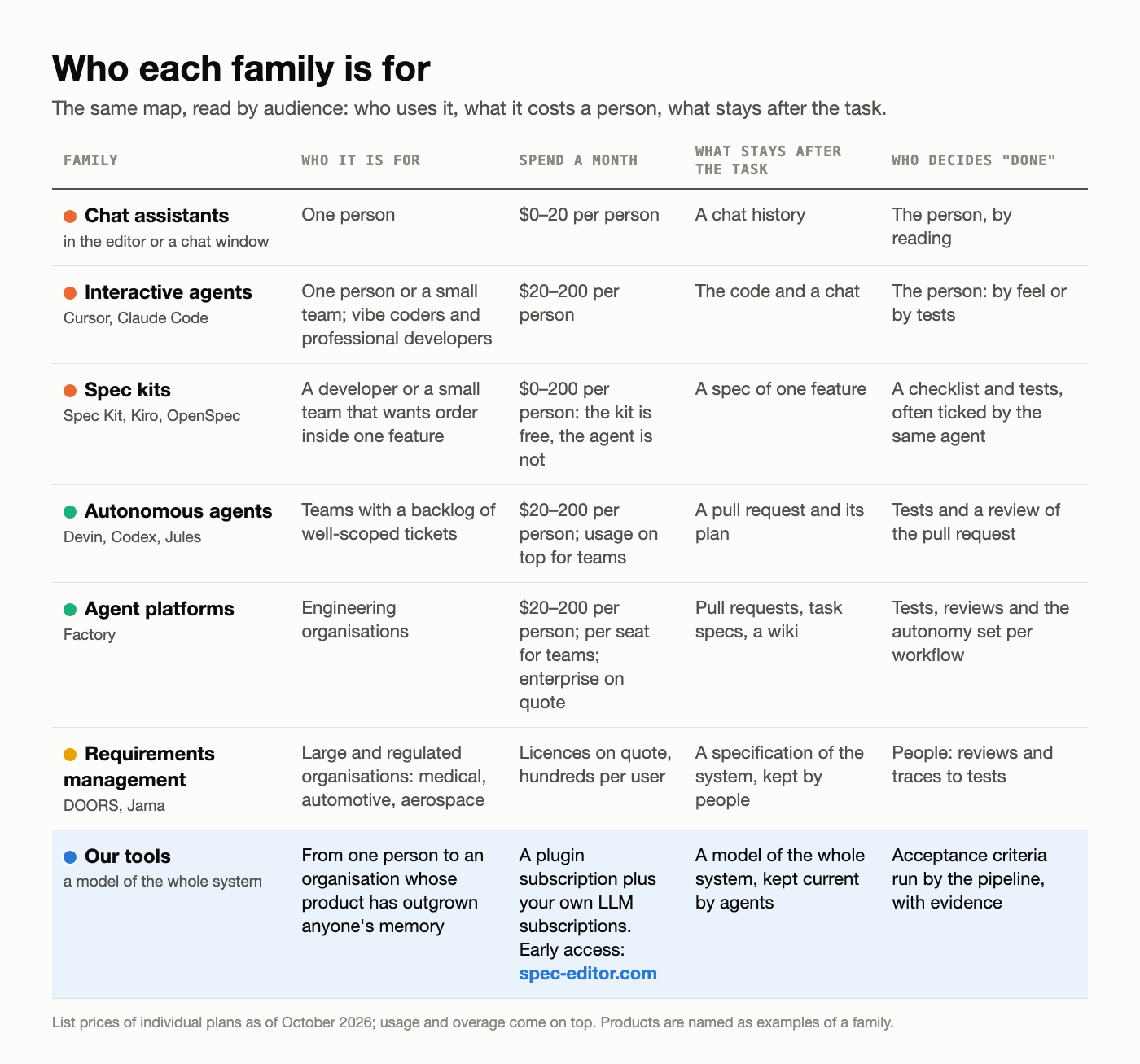
Who each family is for explains a lot:
- Chat assistants and interactive agents serve one person at a keyboard, from a vibe coder building a weekend app to a professional developer. A subscription costs $20–200 a month, and what remains is the code and a chat history. That is enough while the whole product fits in one head.
- Spec kits serve the same people when they want order inside one feature. The spec lives next to the feature and ages with it.
- Autonomous agents and agent platforms serve engineering teams with a backlog of well-scoped tickets, from a handful of developers to an organisation, paying per seat plus usage. “Done” is decided by tests and a review of the pull request.
- Requirements management systems serve large and regulated organisations. There, systems engineers keep a specification of the whole system by hand, under licences priced on quote.
The top right corner is nearly empty: agents that go far on their own and also know the whole system. Autonomy without a specification of the system is safe only while the product fits in someone’s memory. Past that point every task is a fresh guess about what the rest of the system promised, and the tests cover only what the task’s author thought to check.
That corner is where we build. Our tools keep a model of the whole system next to the code, and agents keep it current. Every change answers to a requirement with an address and acceptance criteria, and the criteria run again whenever a change touches the requirement. The price is real: someone has to maintain the model, on every change, not once. We pay for it with analysts and a pipeline, not with people’s memory.
We are opening early access for teams who want to try it.
Positions on the map are my reading of public documentation as of October 2026. These are families, not rankings: each tool is good at what it was built for.
The next post goes back inside our pipeline, to the task a coder gets: what is there now, what should be, where, and how to check it.